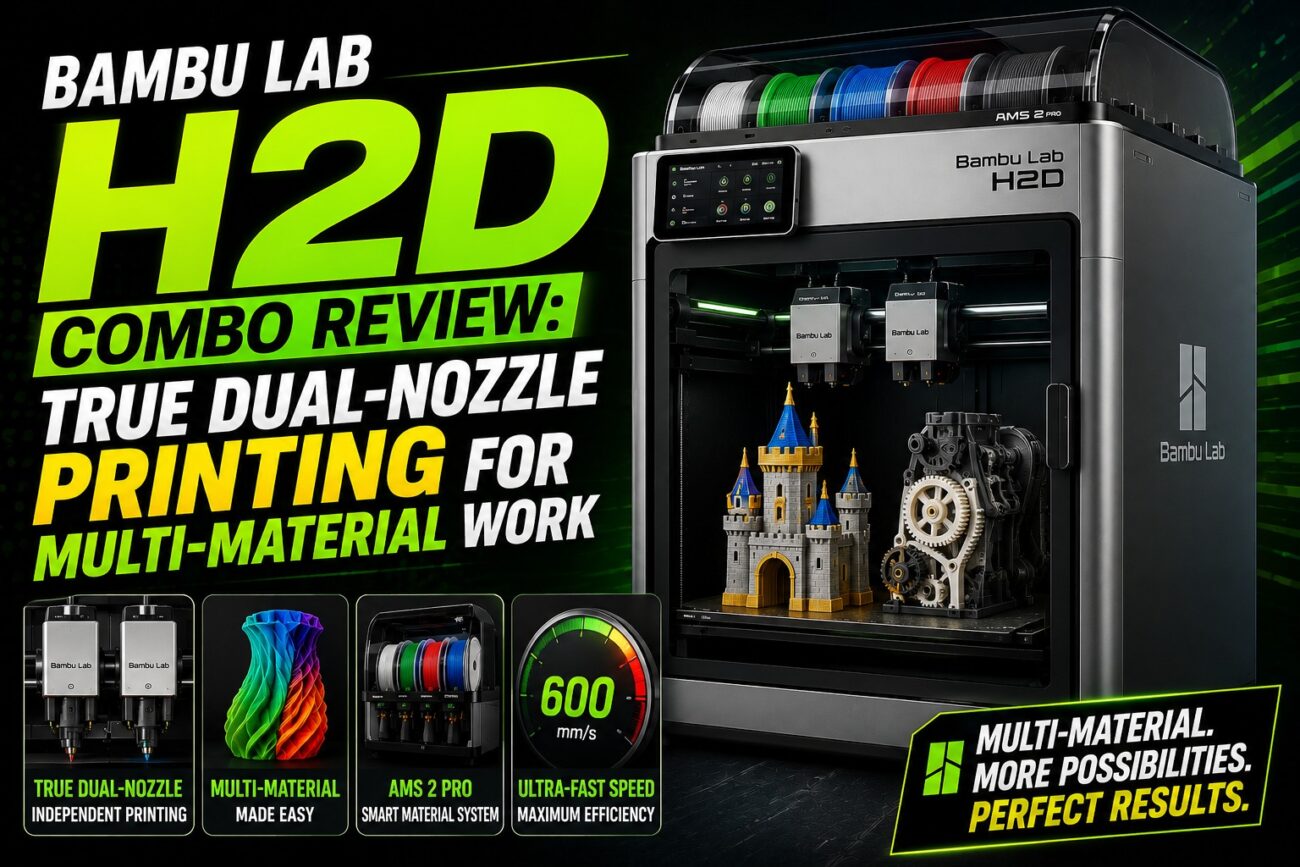
The Bambu Lab H2D Combo is built around a genuinely dual-nozzle (IDEX-style) toolhead, giving it capabilities the single-nozzle H2S can’t match: simultaneous dual-material printing, soluble support materials without swapping, and efficient two-color work without AMS purge waste. It’s the middle tier of Bambu’s H2 professional series, positioned between the simpler, faster H2S and the multi-hotend H2C.
Key Features of the Bambulab H2D combo
True Dual-Nozzle (IDEX-Style) Toolhead
Two independent nozzles allow simultaneous printing with two materials — ideal for soluble supports (PVA) alongside a model material, or true two-color prints without purge waste.
Enclosed, Heated-Chamber Design
Shares the H-series enclosure and heated chamber, enabling reliable printing of engineering materials that need stable ambient conditions.
AMS-Compatible for Extended Multicolor
Pairs with Bambu’s AMS ecosystem for expanded color counts beyond the two native nozzles when needed.
Slightly Slower Single-Color Speeds Than H2S
Because of the heavier dual-nozzle toolhead, the H2D runs more conservative motion profiles for stability, meaning simple single-color jobs print a bit slower than on the single-nozzle H2S.
Complex But Complete Build Volume
Effective usable volume is nuanced due to the dual-nozzle mechanism’s clearance requirements — worth checking Bambu’s published usable-volume specs against the nominal chamber size.
Bambulab H2D combo Full Specifications
Specification | Details |
Nozzle configuration | Dual-nozzle (IDEX-style), true simultaneous dual-material printing |
Frame | Fully enclosed, heated chamber |
Best for | Dual-material printing (e.g., soluble supports), efficient two-color work |
Speed note | Slightly slower than H2S on single-color jobs due to heavier toolhead |
Multicolor expansion | Compatible with AMS units for higher color counts |
Price tier | Starting around $1,749–$1,899 |
Who Should Buy the Bambulab H2D combo?
- Engineering teams needing soluble support material without an AMS purge cycle
- Two-color functional parts and prototypes printed simultaneously
- Studios that want dual-material flexibility without the complexity of a multi-hotend system
- Buyers comparing H2D vs H2C who don’t need 4–7 color production runs
Pros and Cons
Pros
- Genuine simultaneous dual-material printing — not just fast AMS switching
- Enclosed heated chamber supports serious engineering filaments
- Sits in a practical middle ground between the H2S and the more complex H2C
- Compatible with AMS accessories for further multicolor expansion
Cons
- Single-color print speed lags behind the simpler H2S
- Effective build volume is smaller than the raw chamber dimensions suggest, due to dual-nozzle clearance
- Higher cost and complexity than needed for buyers who only print single-material parts
Frequently Asked Questions
Should I buy the H2D or the H2S?
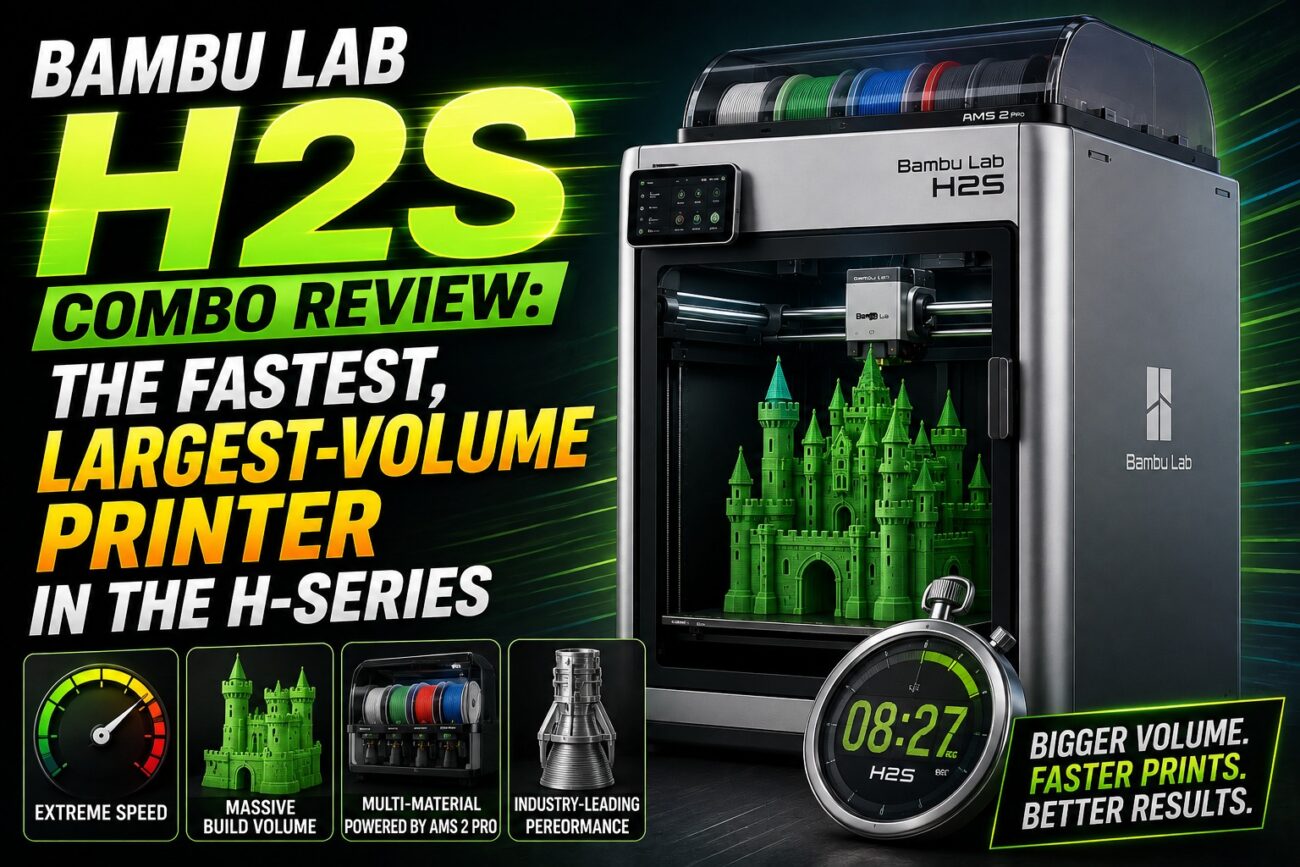
Choose the H2D if you need true simultaneous dual-material printing, like soluble supports. Choose the H2S if you mainly print single-material parts and want the largest build volume and fastest speeds in the H-series at a lower price.
Is the H2D faster than the H2C?
For most workflows the H2D and H2C run similar speed profiles; the H2C’s multi-hotend Vortek system is optimized more for multicolor efficiency than raw speed.
Can the H2D use an AMS for more colors?
Yes, it’s AMS-compatible, letting you combine its native dual-nozzle capability with expanded multicolor printing when needed.
Final Verdict
The Bambulab H2D combo stands out in the dual-nozzle professional 3d printer category for makers who need engineering teams needing soluble support material without an ams purge cycle. With the specifications and real-world use cases outlined above, it’s a strong candidate for anyone evaluating their next 3D printing or scanning investment.
Ready to buy the Bambulab H2D combo? Dream Shapes 3D stocks the Bambulab H2D combo with genuine manufacturer warranty, expert pre-sales advice, and after-sales support. Visit Dreamshapes3d.com to check current pricing and place your order today.